For decades, the Algarve was experienced largely as a seasonal destination — a place for warmth, light and a temporary pause from everyday routines. Weeks of summer living before returning elsewhere. The landscape has not changed. The climate remains generous. What has shifted is the intention behind the arrival.
Increasingly, international buyers are choosing the region not as a retreat but as a primary residence.
The decision is less about escape and more about alignment. Across Europe, North America and beyond, priorities have begun to shift in subtle but decisive ways. After years defined by acceleration and urban density, many are reassessing how their environment supports wellbeing, family life and long-term planning. Lifestyle, once framed as indulgence, is now more often considered a practical priority.
This evolution is reflected in the regional property market. Demand is no longer driven solely by second-home ownership or holiday use. A growing number of buyers are choosing the Algarve as a longer-term base, whether through full relocation, extended seasonal stays or flexible remote working arrangements.
The region offers a combination that remains relatively rare within the European Union: favourable climate, political stability, safety and international accessibility. For globally mobile families and investors, property here is increasingly approached as a lifestyle-driven decision rather than a purely speculative one.
Part of the appeal lies in the region’s relatively measured pace of development. Planning controls along much of the coastline and within protected landscapes have limited large-scale construction, helping preserve the Algarve’s scale and natural character when compared with some Mediterranean resort destinations.
For buyers, this continuity offers a degree of reassurance. What exists today is less likely to be replaced by something entirely different tomorrow. Limited land availability, environmental protections and sustained international demand have contributed to a market that tends to favour long-term stability over rapid expansion.
Portugal’s political environment and its consistent ranking among Europe’s safest countries further reinforce confidence for international buyers considering property with a multi-decade horizon.
Climate inevitably plays a central role in the region’s appeal. Conditions allow daily life to extend outdoors for much of the year. Morning coffee on a terrace becomes routine rather than an occasional luxury. Walking trails, time near the sea and open-air dining integrate naturally into the week.
Over time, this rhythm contributes to well-being in ways that are both simple and practical. For many buyers, this consistency of lifestyle proves as influential as market performance. Quality of life is not framed as an abstract promise but experienced through daily routines.
Accessibility supports this balance. Faro Airport connects the region with major European cities in just a few hours, allowing residents to maintain professional and family ties abroad while living in a quieter environment. The airport also offers seasonal long-haul connections, including direct flights to New York (Newark) and Toronto, as well as convenient one-stop routes to cities across the United States and Canada.
As buyer priorities evolve, so too does the definition of luxury. Increasingly, high-end purchasers seek privacy, landscape integration and architectural coherence rather than density or spectacle.
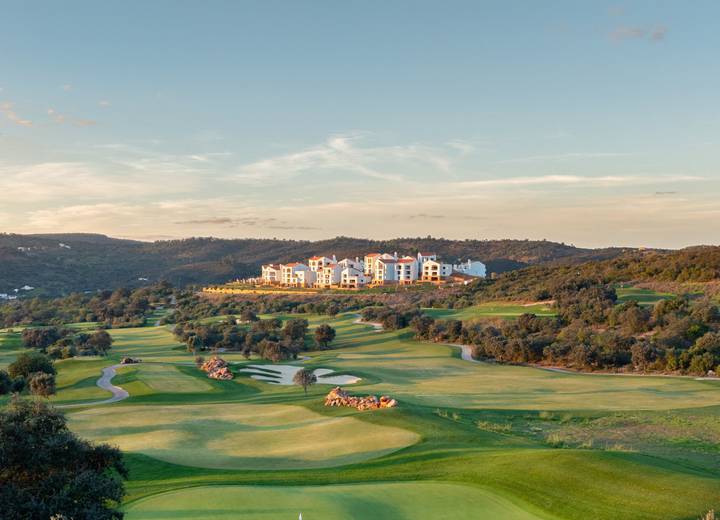
Developments such as Ombria Algarve illustrate this shift. Located in the hills north of Loulé, the development sits between the coastline and the Algarve’s interior landscapes of cork oak forests and rolling valleys. Its masterplan follows the contours of the terrain, maintaining relatively low construction density and preserving open views across the valley.
In settings like this, luxury is expressed less through scale than through integration. Architecture, landscape and privacy are designed to coexist with the surrounding environment rather than dominate it. For international buyers, developments of this kind increasingly represent a benchmark within Portugal’s high-end residential market.
Sustainability has also become closely linked with long-term value. Buyers increasingly recognise that environmental considerations are not simply aesthetic or ethical choices but factors that influence the resilience of a property over time.
Low-impact construction, energy efficiency, water management and landscape preservation are therefore becoming central elements of new developments across the region. In areas where land supply is inherently limited and regulatory oversight remains strong, projects that prioritise environmental sensitivity often benefit from both lifestyle appeal and structural scarcity.
This approach reinforces the Algarve’s position as a property market shaped as much by long-term planning as by short-term demand.
Describing demand purely in financial terms would miss an important part of the picture. Conversations with buyers frequently extend beyond yield projections or capital appreciation. They speak about time regained, about raising children closer to nature and about environments that feel measured rather than compressed.
Remote work has certainly accelerated geographic flexibility, but the underlying motivations predate it. The desire to live more deliberately has been building for years. The Algarve provides conditions in which that intention can be realised without entirely disconnecting from international networks.
For many international buyers today, the decision to purchase property in the region reflects a balance between practical considerations and long-term lifestyle priorities. Climate, safety and accessibility combine with landscape, privacy and architectural integrity.
Developments such as Ombria illustrate how Portugal’s high-end residential market continues to evolve in response to these expectations, offering homes designed not only for immediate enjoyment but for enduring relevance.
For many buyers, property in the region therefore represents more than a straightforward market opportunity. It reflects a longer-term assessment of where quality of life and financial security can reasonably coexist.
Viewed in that context, investment in the Algarve’s higher-end residential market is rarely approached as a purely transactional decision. Increasingly, it is tied to lifestyle considerations — stability, integration into an established international community and an environment that has shown a degree of resilience over time.
Few destinations in southern Europe combine these elements with the same level of consistency.